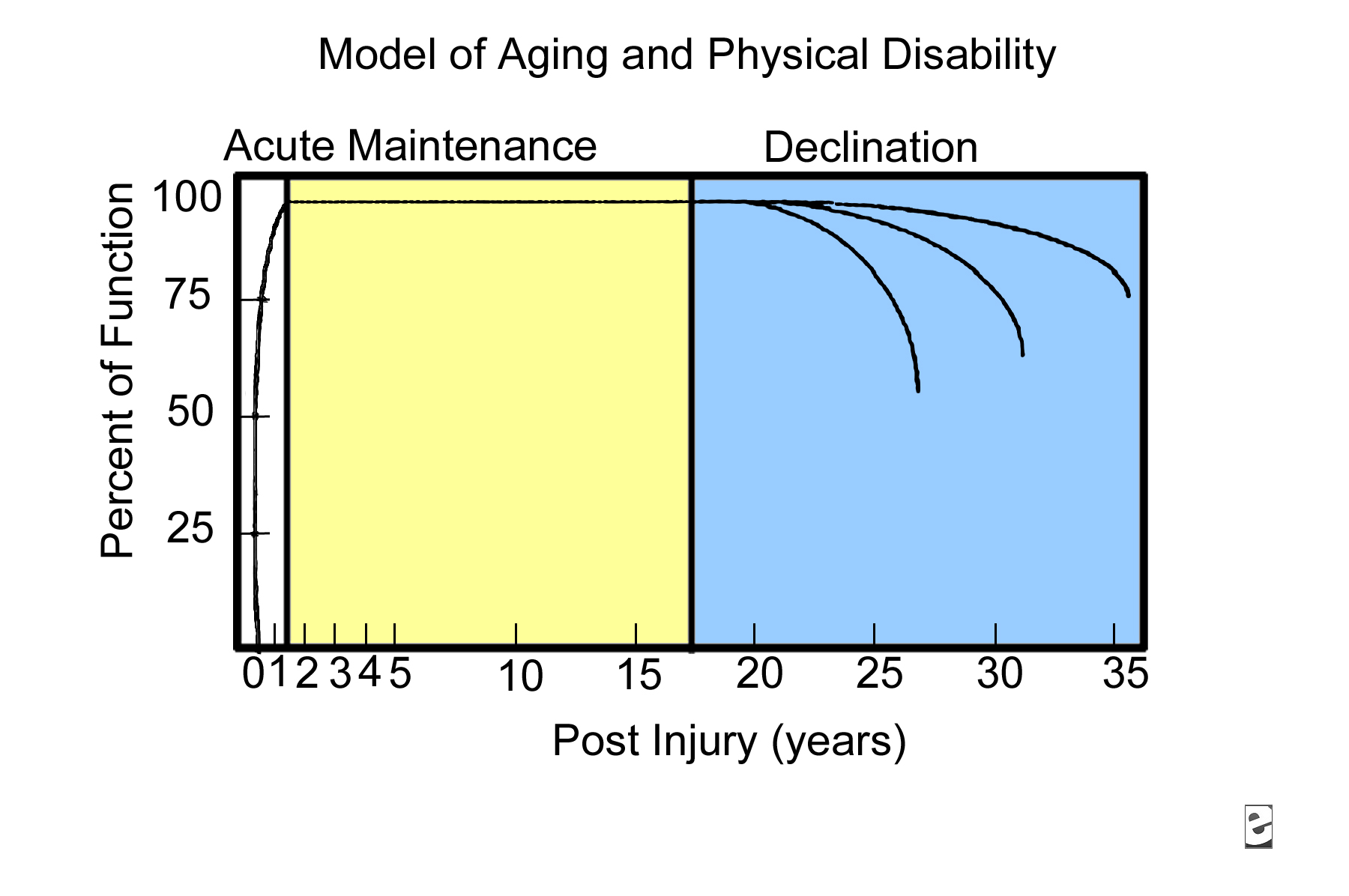
Media file 1: Model of aging and physical disability.
ARTICLE #2: Spinal Cord Injury and Aging
Author: Terry Winkler, MD , Medical Director, Curative Rehabilitation Center; Consulting Staff, Department of Physical Medicine and Rehabilitation, Ozark Area Rehabilitation Services
SPINAL CORD INJURY - THE EFFECTS OF AGING
The characteristics of aging have been well defined through the years. Menter and Hudson describe normal aging as involving 3 processes, all overlapping and distinctly different. These processes include:
This article focuses primarily on the physiological changes in aging.
As individuals age, they experience a variety of new and unanticipated issues. These issues may include medical, functional, socioeconomic, and support problems that typically are planned for poorly. Individuals experience changes and functional declines in all body systems as they age. The rates of decline vary from individual to individual, depending on genetics, body habitus, lifestyle, and general state of health. Williams and Hadler demonstrated that there is variation in the rate of decline for the different organ systems in the body. For example, Katzman reported a 60% decline in pulmonary function by age 80 years, as compared to a 15% decline in nerve conduction velocity. These figures illustrate the different rates of decline in the pulmonary system versus the peripheral nervous system with aging.
In the musculoskeletal system, a loss of calcium eventually leads to osteoporosis. Muscles lose strength and coordination; joint capsules tighten, lose flexibility, and develop contractures; coordination and balance deteriorate. Lean muscle mass is lost and is replaced with adipose tissue. Eventually, a slender athletic build gives way to one that is overweight with a protruding abdomen and somewhat stooped posture. Clark and Siebens summarize musculoskeletal changes as consisting of decrease in muscle mass, muscle fiber size, number of myofibrils, and reduced concentration of mitochondrial enzymes. These changes occur regardless of the level of activity. Muscle strength declines 20-30% after age 60, and maximum power output (the work rate) declines 45% after the fifth decade. Degenerative joint changes in weight-bearing joints essentially are a universal occurrence by age 60.
The central and peripheral nervous systems also experience decline. In the CNS from age 24 years and older, neurons are lost in a slow steady decay process. Clark and Siebens also report normal aging to include decreases in short-term memory, loss of speed and motor activities, and slowing in the rate of central information processing. The peripheral nervous system experiences a decline in the connections and speed with which it can conduct messages. These declines result in decreased balance in strength, coordination, and agility. Physiological changes in the neurologic systems between 25-75 years include over a 60% reduction in vibratory sense in the lower extremities and greater than a 20% reduction in simple reaction time.
The cardiovascular system loses capacity to pump blood through a decreasing stroke volume, as well as the decreased ability to maintain vessel tone. Aging is associated with a progressive gradual increase in systolic and diastolic blood pressures, likely related to a loss of arterial elasticity. An increased incidence of orthostatic hypotension exists, as well as syncope syndromes associated with micturition.
The pulmonary system experiences a decreased compliance or elasticity of the lung tissues interfering with the ability to expand on inspiration. In addition, the chest wall loses its flexibility and muscle strength leading to a restriction of pulmonary function. Vital capacity, maximum voluntary ventilation, expiratory flow rate, and forced expiratory ventilation all decline with aging.
In the GI tract, transit time increases resulting in incomplete absorption of some medications and over absorption of others; excessive water re-absorption due to the prolonged transit time can lead to dilated or enlarged colon, rectal fissures, and hemorrhoids. A decreased force and coordination of smooth muscle contraction in the colon is associated with aging.
Endocrine changes include a reduction of hormones responsible for repair and maintenance of cellular tissues, such as human growth hormones and testosterone. Reduction in the levels or the effectiveness of insulin and insulin-like growth factor also takes place. In general, as one ages, the immune response system, both cellular-mediated and humeral-mediated, decline in their effectiveness.
The integumentary system experiences a loss of subcutaneous supporting and adipose tissue, and thinning of the skin with loss of elasticity. Skin tears and bruising become much more common with age.
The renal system loses functional units or glomeruli, which can result in some renal insufficiency. Incontinence is not considered a normal part of the aging process.
Fortunately, all of the body's organ systems have a large functional reserve capacity. For most individuals, the natural decline in these body systems is only a minor nuisance or inconvenience until late in life. Clark and Siebans report that at age 65 years, men can expect greater than 80% of their remaining life expectancy to be free of disabilities. Further, only 5% of elderly individuals are expected to live in an institution at some point. Additionally, and the percentage of adults aged 75-84 years who require assistance with activities of daily living (ADL) is approximately 11%. For persons older than 85 years, only 23% require assistance with some ADL (Kennedy, 1997). In 1999, Kane et al showed that at age 85 years, 55-60% of persons may require assistance with instrumental ADL (IADL). These levels of independence in ADL are in marked contrast to the level of independence of the average person with spinal cord injury (SCI).
The individual with SCI typically is young at the time of injury and, as a result of the SCI, experiences an immediate reduction of some of the functional reserves and capacities that were present, and, as a result he or she often requires assistance with ADL. In other body systems, the patient with SCI experiences a more rapid decline and assumes the characteristics associated with aging that were described in the paragraphs above at an earlier age.
MUSCULOSKELETAL CHANGES AND THE EFFECTS OF AGING WITH SPINAL CORD INJURY
Upper extremity pain is a common problem associated with SCI and is most often due to either peripheral nerve entrapments or overuse syndromes. Subbarao et al reported that greater than 70% of individuals with chronic SCI report pain in their upper extremities. Most of these individuals require some sort of treatment for the pain or modification to their activities. The pain has been reported to increase with time after the onset of the injury.
Alijure et al have reported that the incidence of peripheral nerve entrapment increases with the number of years since the onset of SCI. Davidoff et al report that nearly two thirds of individuals with SCI have compressive neuropathies in the upper extremities with greater than 50% having median neuropathy and 25% having neuropathy bilaterally in the upper extremities.
The most common overuse syndromes causing pain in the upper extremities are degenerative joint diseases, rotator cuff tears, rotator cuff tendonitis, subacromial bursitis, and capsulitis according to Kirshblum et al. Other musculoskeletal complications include fractures of the lower extremities, which are reported to occur in as many as 6% of individuals, with the most common fracture occurring at the femur. As many of 10% of these fractures result in a nonunion.
Nearly all pediatric patients with SCI experience scoliosis (97%). In adults with SCI, just slightly less than 50% develop scoliosis.
Osteoporosis occurs uniformly in individuals with SCI with bone loss beginning immediately after the injury. Garland et al describe a reduction of bone mineralization as high as 22% in the first 3 months post-injury. Bauman et al have clarified the studies on bone loss, and it has been demonstrated that there is a continual linear loss of bone that is a function of time since the occurrence of SCI. Bauman's studies have been conducted on identical twins, where one twin has a SCI and the other is able-bodied. Individuals with a Brown-Séquard-type SCI have been shown to have greater bone loss in the paretic extremity as compared to the stronger extremity. People with SCI reach the fracture threshold levels of osteoporosis in the proximal femur within 1-9 years post onset of SCI (Szollar, 1998).
Soft tissue changes occur as a result of aging with SCI. The areas over weight-bearing surfaces (the buttocks) experience a loss or thinning of the subcutaneous tissues. This results in thinning of the skin and a loss of elasticity. These effects result in skin that is subject to breakdown and is harder to heal once a pressure sore or ulcer has developed. The rate of decubitus ulcers increases with time after the onset of SCI. Rossier et al, as well as other authors, have described a loss of lean muscle mass that occurs with time. Bauman also has described body composition changes that can be summarized as a loss of lean muscle mass and an increasing percentage of body adipose tissue that occurs as a function of time. Most individuals with SCI experience weight gain that increases with time and eventually reach a level of obesity that poses significant limitations on their functional capabilities.
THE CARDIOVASCULAR SYSTEM OF A MAN WITH SPINAL CORD INJURY
Kochina has reported that the incidence of cardiovascular disease among individuals with SCI is over 200% higher than what is expected in age and gender-matched control population. In individuals surviving 30 years or longer following SCI, nearly 50% of all deaths occur due to premature cardiovascular disease.
Hypertension is nearly twice as common in individuals with paraplegia as in able-bodied controls.
Individuals with SCI have a reduced exercise tolerance because of ineffective distribution of oxygenated blood. Venous return to the heart is limited because of decreased sympathetic tone and a decreased muscular pumping action of the lower extremities, leading to pooling.
Homocystine levels have been reported to be elevated in men with SCIs, and the levels increase with duration of SCI. In addition, levels of prostacyclin receptor antibody increased with duration of SCI, which, in turn, can result in platelet aggregation.
GASTROINTESTINAL CHANGES
GI complications in SCI are numerous, both with acute and chronic SCI. Following chronic SCI, colonic compliance and motility decrease. Electromyographic studies have shown that basal colonic myoelectrical activity is higher in persons with SCI than in controls. Problems associated with GI tract dysfunction increase with age after SCI. Seventy four percent of patients with SCI develop hemorrhoids, 43% develop abdominal distention, 43% experience autonomic dysreflexia related to the GI tract, and 20% develop difficulty with bowel evacuation. The prevalence of GI complaints increases with time after the onset of the injury. Sixty percent of tetraplegic patients require assistance with managing their bowel routine, as do approximately 16% of paraplegic patients.
Functional ability to manage neurogenic bowel incontinence can change as the individual ages or gains weight. The frequency of GI complications and problems is greatest in individuals aged 60 years or older or who sustained their injuries 30 years or longer ago. Frisbie et al reported a higher than expected incidence of colorectal cancer in these patients. A greater frequency of bowel dysfunction is reported in individuals with SCI who have been injured 5 years or longer.
PULMONARY AND INTEGUMENTARY CHANGES
Pulmonary
Declining pulmonary function can be a result of restrictive disease, obstructive disease, or a combination of the two. In SCI, restrictive lung disease occurs as a result of respiratory muscle paralysis. The higher the level of SCI, the greater the restrictive impairment. Dicpinigaitis et al described an obstructive airway disease that can be described best as hyperactive airway disease in individuals whose SCI occurs at T6 and above. The development of kyphosis, scoliosis, or increasing spasticity can cause further restrictive disease as the individual with SCI ages.
Sleep apnea has been reported to be present in 40% of individuals with SCI. The frequency of obstructive sleep apnea increases with age. In all those individuals with SCI who experience sleep apnea, only 25% are found to be obese. Long-term use of baclofen may be associated with the development of obstructive sleep apnea.
Integumentary
During the first year after the onset of SCI, approximately 15% of patients develop a decubitus ulcer. The rate of decubiti dramatically increases by 20 years post SCI, to 30%. In addition, sitting tolerance decreases as the person becomes more susceptible to this complication (Bauman, 2004).
ENDOCRINE CHANGES
Numerous endocrine changes have been described. The rate of diabetes has been reported to be 4 times higher in SCI patients than in the general population. After glucose tolerance testing in SCI patients, 22% were found to have diabetes, with an additional 34% having impaired glucose tolerance. Bauman has demonstrated abnormally low levels of human growth hormone and testosterone in individuals with SCI. Low levels of these hormones can result in a reduced capacity for cellular repair and can lead to a reduced capacity for maintaining lean muscle mass and strength. In addition, low levels of these hormones can prolong healing and soft tissue repair following injuries. Approximately 10% of the US population has high-density lipoprotein cholesterol values less than 35 mg/dL, but 24-40% of persons with SCI have levels below this value (Bauman, 2004).
A number of long-term follow-up studies and many authors have documented the tendency for individuals with SCIs to age faster than the able-bodied population. That is to say that individuals with SCI develop characteristics and medical problems commonly associated with the aging process at a much younger age. Some authors have provided assistance in helping to determine when these changes may occur.
Menter and Hudson have developed a model of aging that predicts functional decline of the individual with duration of SCI as a result of the many changes that have been discussed. This model consists of the following 3 phases:
The acute restoration phase occurs immediately following SCI when the individual goes from having very little functional capabilities to regaining the maximum amount of functional return during rehabilitation. This phase is followed by the maintenance phase, which is variable in length of time where the individual with SCI can enjoy a relatively stable level of function. This period is followed by a predictable functional decline that occurs as a result of degenerative effects of overuse syndromes and the physiologic aging process.
A number of studies have validated the occurrence of this functional decline, which may begin as early as 10-15 years post-injury or as late as 20 years post-injury, depending on the unique set of circumstances. Cushman and Hassett evaluated people with SCI of 15 years or more and found that 93% had experienced a decline in functional status at that point. One important thing to keep in mind is that not everyone who has SCI ages in the same way or at the same rate. A large number of factors are important to consider including genetics, life styles, level of injury, age, weight, health history, level of support care, level of SCI, and co-morbidity. These considerations are discussed in more detail in the Spinal Cord Injury Desk Reference and Guidelines for Life Care Planning and Case Management .
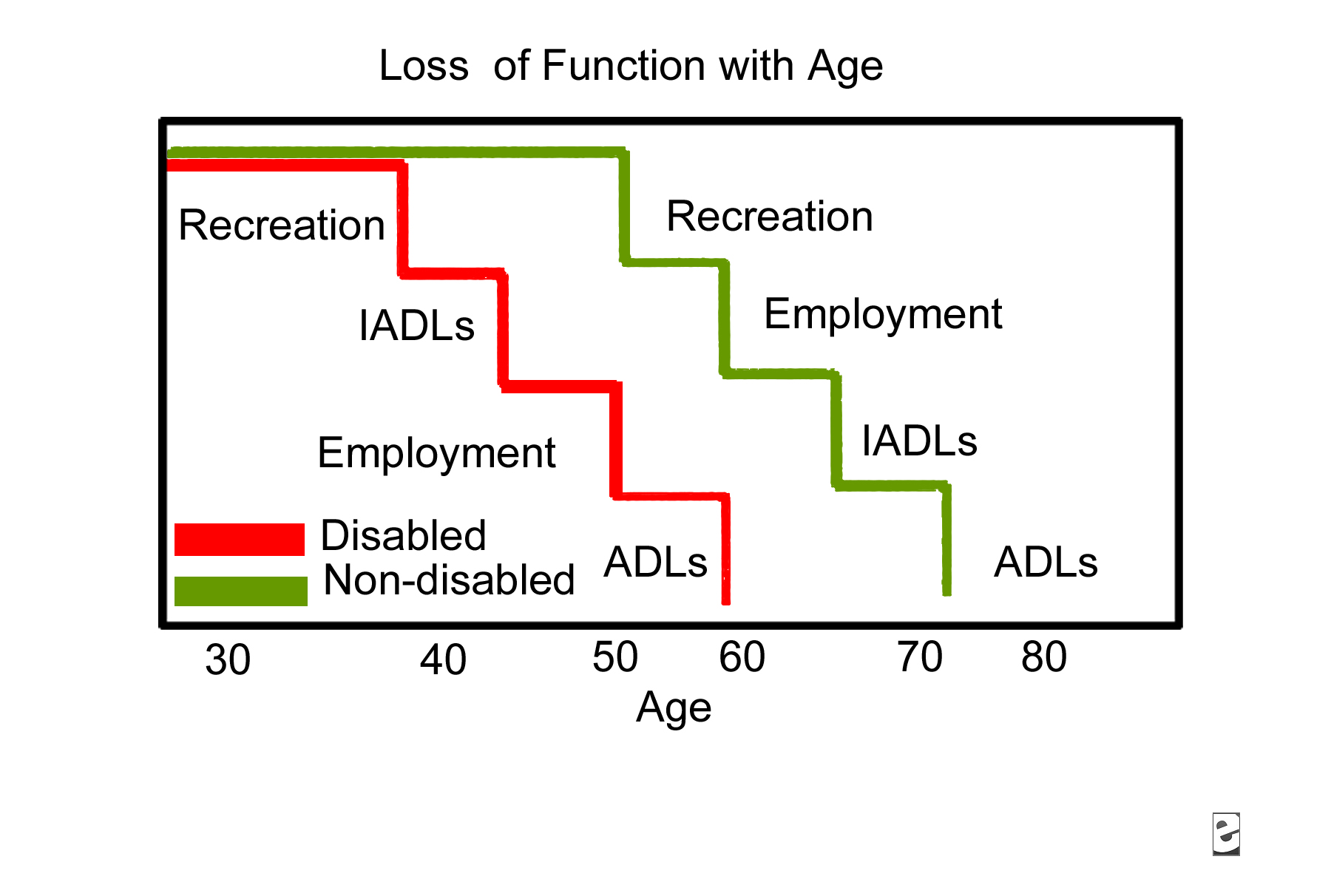
The age of the individual at the onset of SCI is an important consideration in estimating the duration of SCI before functional decline begins. Kempt and his colleagues at Rancho Los Amigos have developed a model for this factor. Younger individuals whose age at SCI onset is during or prior to adolescence may enjoy a maintenance phase of 20 years prior to experiencing functional decline, whereas individuals who are aged 55 years at the onset of their SCI may only have 5-7 years of relatively stable functioning status prior to experiencing a decline. Thomlinson has described a functioning decline in major life areas such as recreation, independent ADL, and employment in the disabled population, as compared with the general population. In each of these major life areas, the functional decline is experienced at a much earlier age in the disabled population than in the nondisabled population.
Ample evidence suggests that the individuals with SCI experience age-related changes as a result of their SCI at a much earlier age than would be anticipated in an individual without SCI. The combined effect of these changes results in a functional decline for the individual for SCI. Ample current convincing evidence in the literature indicates that the process of aging interacts with SCI to compound the level of disability as times goes by. Health care professionals providing care to individuals with SCI must be aware of these changes and implement services to limit the functional decline to the extent possible, or provide services or equipment to the individual in a proactive way to replace lost function or limit the effects of the functional decline to the extent possible.
Further discussions on these issues can be found in the Guide to Rehabilitation by Deutsch and Sawyer; the text Life Care Planning and Case Management Handbook , editor Roger Weed, CRC Press, Boca Raton, Florida, and in Spinal Cord Injury Desk Reference, Guidelines for Life Care Planning and Case Management published by Demos Medical Publishing.
ACTIVITIES OF DAILY LIVING
With each passing decade, the odds that a person will need more assistance with ADLs increases 42% (Liem, 2004). The same study demonstrated that in a group of people who were 20 years post SCI, 33% report needing more assistance with ADLs in at 3-year follow-up. The ADL most affected were bathing, transfers, and dressing. Another researcher added that the IADL with which people with SCI need increased help included household chores, shopping, and meal preparation. The most commonly sited reasons for needing more assistance with ADL or IADL are more weakness, increasing pain, or increasing weight. In addition, the cumulative changes brought on by the number of years post SCI had a greater effect on the need for assistance with ADL than did the persons actual chronological age.
EFFECT OF PAYER SOURCE
Studies reveal that having a public source of health care funding such as Medicare or Medicaid increases the SCI individual risk of mortality to 1.47-2.31 above those who have other sources to fund their health care (Krause, 2002). These data were collected and published prior to cutbacks in funding for public care, which began in 2002. Of all adults with severe disabilities, 80% receive their health care through Medicare and/or state Medicaid programs (Hagglund, 2003). Many states are reducing funding for Medicaid programs, which will surely further impair the quality of health of persons who depend on these programs.
MULTIMEDIA
|
|
|
|
Media file 2: Loss of function with age. ADL is activities of daily living. IADL is instrumental activities of daily living. |
|
|
|
REFERENCES