Reprinted with the permission of the Urban Institute: http://www.urban.org
ARTICLE #5: Understanding Homeless Youth: Numbers, Characteristics, Multisystem Involvement, and Intervention Options
Testimony submitted by
Martha R. Burt, Ph.D. (1)
Principal Research Associate and Director, Social Services Research Program
Urban Institute
Before the U.S. House Committee on Ways and Means
Subcommittee on Income Security and Family Support
June 19, 2007
Chairman McDermott and Members of the Committee:
Thank you for inviting me to share my views relating to homeless youth, and especially to their involvement in public systems under the supervision of this committee. I have been involved in policy-oriented research on homeless populations and homeless service systems since 1983, when the first Emergency Food and Shelter Program legislation was passed, and have also spent considerable time trying to understand strategies that are able to reach multi-problem youth and help them move toward a productive and responsible adulthood. So it is a pleasure for me to be asked to give testimony on a matter that has not received either the research or policy attention it deserves.
I have been asked to address three issues:
- How big is the problem—how many homeless youth are there?
- Who are homeless youth—what are their characteristics, and what factors predispose youth to become homeless? and
- What might be the most promising points and types of intervention? (2)
HOW BIG IS THE PROBLEM?
There are no reliable statistics on the number of homeless youth, in part because this is a notoriously difficult population to find and count, and in part because everyone defines the population differently. This Subcommittee has stated that its interest is in the population of youth and young adults age 16 to 24. This age range includes both minors and adults, which usually means that data must be drawn from different ongoing national surveys just as different systems of public and private support and intervention serve minors and adults.
There are also issues of what one means by “homeless”—does one night away from home without permission count, or two nights, or do we want to focus on the youth who truly have no place to go back to and spend years on the streets? Estimates have to be cobbled together from different sources, or special surveys have to be conducted, each of which has its limitations. I am happy to say more about definitional and methodological issues if asked, but assuming the Subcommittee is interested in our best guesses, they are the following:
- For youth age 12–17, two estimates from quite different sources fall in the range of 1.6 to 1.7 million a year (between 7 and 8 percent of all youth in those age ranges). This estimate is at the high end because it is very inclusive, counting short unauthorized absences from home or “throwaway” experiences of getting kicked out for a period of time as well as long-term separation from family or having nowhere to return (Ringwalt et al. 1998; Hammer, Finkelhor, and Sedlak 2002). A higher proportion of episodes occur among older than among younger youth. Further, most of these episodes are very short, with the result that about 300,000 to 400,000 youth might be expected to be homeless on any given day.
- Youth using homeless youth shelters are usually homeless for the first time and have not been homeless long. Information about youth in these shelters, which are usually funded by the Family and Youth Services Bureau of the Department of Health and Human Services (DHHS), can be obtained through RHYMIS, that system's management information database. Street youth are the opposite—unattached to shelters and on their own without adult supervision for periods that can exceed several years. Information about this part of the homeless youth population is only available through special studies.
- Homelessness among young adults, age 18 to 24, may be studied within the homeless assistance system that serves adults. Still the best source of that information, although now dated, is the National Survey of Homeless Assistance Providers and Clients (NSHAPC), which was conducted in 1996. Urban Institute researchers developed estimates of the homeless population from NSHAPC, from which we can estimate the numbers of 18- to 19-year-olds and 20- to 24-year-olds among the adult homeless population (Burt, Aron, and Lee 2001).
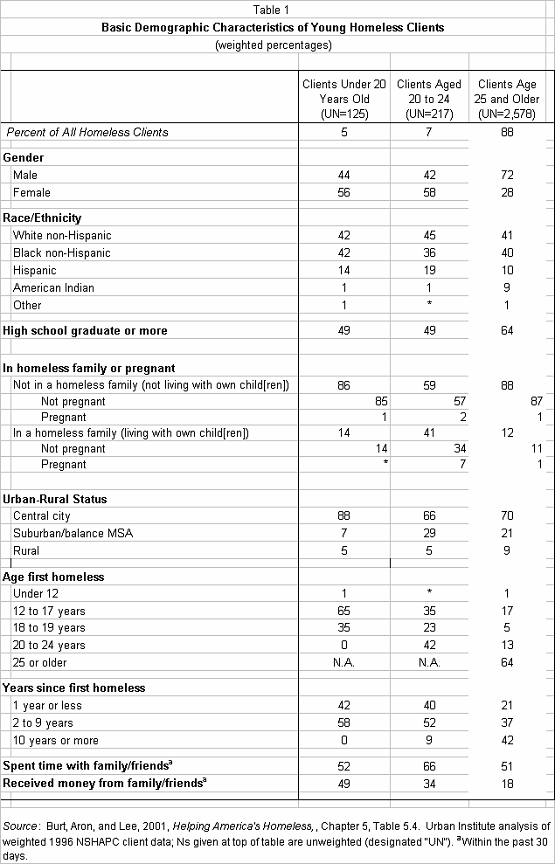
- 18- to 19-year-olds are 5 percent, or 22,000 to 44,000, of the homeless population on a single day, or about 80,000 to 170,000 over the course of a year.
- 20- to 24-year-olds are 7 percent, or 31,000 to 59,000, of the homeless population on a single day, or about 124,000 to 236,000 over the course of a year.
WHO ARE HOMELESS YOUTH?
- Gender —In shelter samples, whether in youth or adult shelters, the proportions of males and females tend to be about equal. The older and the more “street” the sample, the more males.
Race/ethnicity —As with samples of homeless adults, race/ethnicity distributions depend heavily on the race/ethnicity distribution of the entire community.
- Sexual minorities —Research findings on the proportion of homeless youth who are gay, lesbian, or bisexual vary, from a low of about 6 percent from youth-services-center samples to as high as 11 to 35 percent in street samples. Sexual minority status is a powerful risk factor for youth homelessness, as disclosure to a parent or a parent's discovery of that status may lead to being thrown out or running away.
- Pregnancy —Homeless youth are three times as likely as national samples of youth to be pregnant, to have impregnated someone, or to already be a parent. Pregnancy may be the result of having no way to obtain money other than through prostitution (survival sex) when already homeless or ejection from home because of the pregnancy. This trend continues for homeless young adults age 18 to 24 (see appendix, table 1).
- Length of time homeless —As noted, youth using runaway and homeless youth shelters tend to have been homeless only once and for a short period of time. NSHAPC data on young adults shows that more than half had been homeless for two to nine years. Two-thirds of those age 18 to 19 had first become homeless before they were 18; the same was true for a third of those age 20 to 24 (see appendix, table 1).
RISK FACTORS FOR HOMELESSNESS AMONG YOUTH
In addition to pregnancy and sexual minority status, a number of factors may contribute to a youth becoming homeless and to the separate issue of a youth remaining homeless.
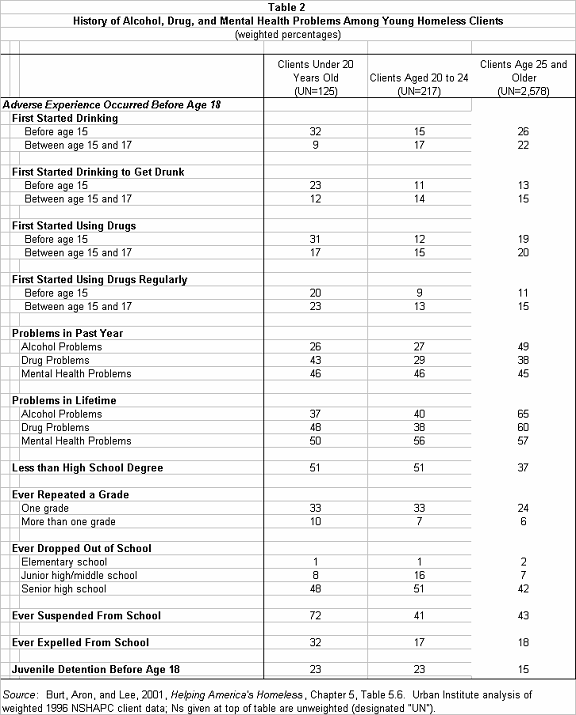
- School difficulties —About half of homeless youth have not finished high school, with the proportion going up the younger the youth. Between one-fourth and two-fifths of homeless youth have had to repeat at least one grade in school. Among young adult homeless people, the majority have been suspended and/or expelled from school (see appendix, table 2).
- Substance abuse —Thirty to 40 percent of homeless youth report alcohol problems in their lifetime, and 40 to 50 percent report drug problems. These percentages are smaller than for older homeless people, but homeless youth tend to have started younger, often before age 15. This early use and abuse is predictive of serious adult addiction problems and long-term homelessness (of 18- to 19-year-olds in NSHAPC, 23 percent began drinking to get drunk before age 15, and 20 percent began using drugs regularly at that early age) (see appendix, table 2).
- Mental health problems —Forty-five percent of homeless youth reported mental health problems in the past year, 50 to 56 percent did so over their lifetime. These rates are not different than for older homeless adults, but they are predictive of becoming homeless and remaining homeless (see appendix, table 2).
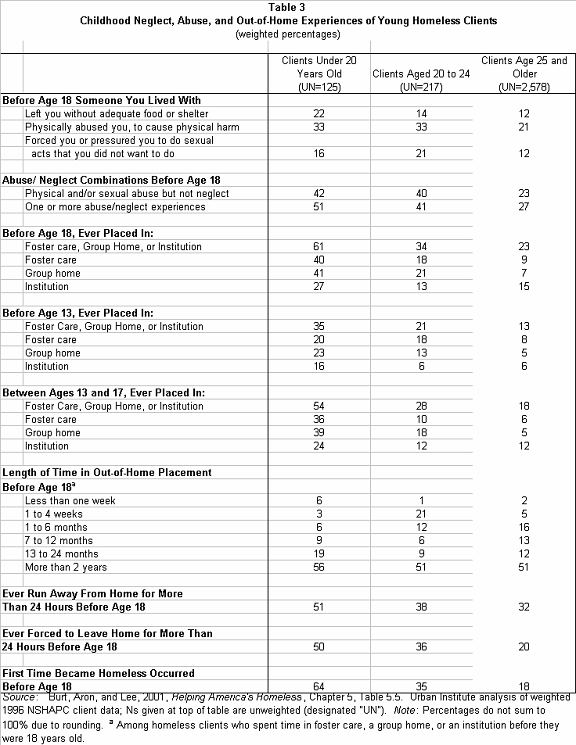
- Family conflict and child maltreatment —Very high proportions of homeless youth report family conflict as a reason for being homeless. Almost twice as many young adult homeless people report abuse and neglect experiences as do older homeless people (see appendix, table 3).
- Out-of-home placement and foster care —Abuse and neglect experiences increase the likelihood of child welfare involvement and out-of-home placement, and life on the street increases the likelihood of criminal involvement.
-
- 61 percent of 18- to 19-year-old NSHAPC young adults had been in out-of-home placements—a rate more than two and a half times that reported by homeless adults 25 and older. The 20- to 24-year-old NSHAPC population was in the middle. Further, the younger group was more likely to have been removed from their home before age 13 and to have spent more time in out-of-home placement. Half had been forced to leave home when they were a minor (see appendix, table 3). About a quarter of NSHAPC young adults had been in juvenile detention, compared with 15 percent of older homeless people.
- The association between child welfare involvement and shelter use as an adult works both ways. Studies in New York City indicate that 29 percent of emergency shelter users had been involved with child welfare services, of whom three-quarters had been placed outside the home (Park, Metraux, and Culhane 2005). Thus, out-of-home placement is a decided risk for homelessness (in the general population, only about 3 percent of adults have been so placed). Looked at from the child welfare perspective, 19 percent of former child welfare service users entered public shelters within 10 years of leaving child welfare. Those placed outside the home were twice as likely as those that just received preventive services to enter a shelter (22 versus 11 percent), while absconders from foster care had the highest rate of subsequent homelessness (Park et al. 2004a).
- Finally, having been homeless as a child, with one's parent(s), is associated with subsequent child welfare involvement. Eighteen percent of such children became involved with child welfare within five years of their first shelter admission, with recurrent use of shelters (i.e., repeated homeless episodes) being a strong predictor of child welfare involvement (Park et al. 2004b).
-
- Juvenile justice involvement —every year about 200,000 youth age 10 to 24 leave detention and correctional facilities. Most do not have a high school diploma, nor have they ever held a job. They frequently have physical health, mental health, and/or substance abuse problems. And they most commonly go back to neighborhoods that will expose them to the same risk factors for getting into trouble that put them into the justice system in the first place. Several studies, summarized by Toro et al. (2007), indicate that these youth have high probabilities of ending up homeless.
All the statistics we can assemble suggest that many kinds of trouble may lead to youth homelessness. The very large majority of youth who experience a runaway, throwaway, or homeless episode manage to leave homelessness and not return. But the longer a youth has been homeless, the more likely he or she is to be in many kinds of trouble and to have been for a long time (Toro, Dworsky, and Fowler 2007). Further, the longer the period of youth homelessness is and the more barriers a youth faces, the higher the risk that the youth will end up as a chronically homeless adult. Indeed, many homeless street youth today would meet HUD criteria for chronic homelessness if they were adults.
INTERVENTION OPTIONS
A general rule of thumb for selecting among intervention points and intervention types is “go for the hardest-core you can find.” Thus, with homeless youth, the largest waste of human potential, along with the biggest costs to society, lies with multiproblem youth, who are quite often involved with two or more public systems and who have the highest risk of becoming and remaining homeless. This may seem counterintuitive, and it is often not politically popular. But a good deal of research indicates that while interventions with the “hardest-core” parts of a population are the most expensive, they also yield the most impact for the investment. This is because these are the people who are pretty much guaranteed not to solve their own problems if left to their own devices.
The runaway and homeless youth shelter network, supported and overseen by the Family and Youth Services Bureau of the DHHS, already focuses on the large component of the runaway youth population that potentially has a home to go back to. Follow-up studies indicate that the very large majority of these youth (up to 90+ percent) reunite with their parents, progress to living on their own, or live with friends, but do not continue in or return to homelessness. While expanding the numbers and locations of these programs would always be desirable, such an expansion would not make much difference for the street youth population because very few of the latter population use these programs.
The intervention points that are likely to yield maximum payoff are the periods surrounding institutional release—the 24,000+ youth who turn 18 while in foster care and the 200,000+ youth who leave juvenile or corrections facilities every year are those among the general youth population who have the highest risk of becoming homeless and of staying homeless or reentering institutions if nothing is done to intervene.(3) The period surrounding the end of substance abuse treatment or psychiatric hospitalization is another potentially fruitful intervention point.
Some research on the Chafee Foster Care Independence Program (FCIA) indicates that this strategy has promise. The FCIA doubled allocations to states to ease transition from foster care and allows states to use 30 percent of funds to pay for housing for youth older than 18 but not yet 21. Research summarized by Toro et al. (2007, 14–17) indicates that the youth who receive this type of support are less likely to become homeless during the transition period, and are also more likely to be in college, have access to health care, and not be involved in the criminal justice system. Further follow-up interview waves will shed light on whether these differences persist once youth reach age 21.
In Denver , Urban Peak runs two housing programs that address, respectively, the needs of youth aging out of foster care and long-term street youth. The first is a partnership between Urban Peak and the state child welfare department to provide permanent supportive housing for children in or about to leave state custody who are or have been homeless. The second uses HUD funding and local service dollars to create permanent supportive housing for street youth with disabilities, to allow them to stabilize and get their lives together (Burt, Pearson, and Montgomery 2005).
Throughout the country, adult corrections departments are realizing that it is in their interest to partner with homeless assistance networks as well as employment, mental health and substance abuse agencies to ease the transition from incarceration to community. This movement is driven by the bottom line for corrections departments—two-thirds of releasees will be back within three years if they do not receive transitional assistance. The return of such a large proportion of releasees is extremely expensive for corrections departments, and they are finally realizing that it is in their interest to do something about it. The same could be happening with juvenile justice institutions and the young adult facilities run by adult corrections departments.
CONCLUSIONS
A surprisingly large proportion of youth age 16 to 24 will experience at least one night of homelessness. A much smaller proportion will spend a lot of time homeless, as youth and later as adults. The factors that propel youth toward homelessness are often the same ones that keep them there or that create the conditions for repeat episodes. We do not have much research evidence capable of guiding us toward the most effective interventions to prevent or end youth homelessness. What we do have suggests that we should pick points of maximum leverage, such as when youth are leaving institutional care, and provide “whatever it takes” to ensure that they can avoid homelessness and ultimately transition to lives of self-sufficiency.
REFERENCES
- Burt, Martha R., Laudan Aron, and Edgar Lee. 2001. Helping America 's Homeless: Emergency Shelter or Affordable Housing? Washington , DC : Urban Institute Press.
- Burt, Martha R., Carol Pearson, and Ann Elizabeth Montgomery. 2005. Strategies for Preventing Homelessness. Washington , DC : Department of Housing and Urban Development.
- Hammer, H. David Finkelhor, and Andrea Sedlak. 2002. Runaway/Thrownaway Children: National Estimates and Characteristics. National Incidence Studies of Missing, Abducted, Runaway, and Thrownaway Children (NISMART), October 2002. Washington , DC : Office of Juvenile Justice and Delinquency Prevention, Department of Justice.
- Orlebeke, Britany. 2007. “Making the Child Welfare System Work for Older Youth.” Presentation at Thursday's Child, Urban Institute, Washington , DC , June 14, 2007 .
- Park, Jung M., Stephen Metraux, and Dennis P. Culhane. 2005. “Childhood Out-of-Home Placement and Dynamics of Public Shelter Utilization among Young Homeless Adults.” Children and Youth Services Review 17(5): 533–46.
- Park, Jung M., Stephen Metraux, Gabriel Brodbar, and Dennis P. Culhane. 2004a. “Public Shelter Admission among Young Adults with Child Welfare Histories by Type of Service and Type of Exit.” Social Services Review 78: 284–303.
- ———. 2004b. “Child Welfare Involvement among Children in Homeless Families.” Child Welfare 83(5): 423–36.
- Ringwalt, Chris, James M. Greene, Marjorie Robertson, and M. McPheeters. 1998. “The Prevalence of Homelessness Among Adolescents in the United States .” American Journal of Public Health 88(9): 1325–29.
- Toro, Paul, Amy Dworsky, and Peter Fowler. 2007. “Homeless Youth in the United States : Recent Research Findings and Intervention Approaches.” Paper presented at the Second National Homelessness Research Symposium, March 1–2, Washington , D.C.
APPENDIX
Note: Table 1 (below) was reproduced directly from the original. Formatting problems could not be corrected.
Footnotes:
(1) This testimony draws on my own and other researchers' published and unpublished work. The views expressed are mine alone and do not necessarily reflect the views of any organization with which I am affiliated.
(2) For a recent comprehensive overview of youth homelessness, see Paul Toro, Amy Dworsky, and Patrick Fowler, “Homeless Youth in the United States : Recent Research Findings and Intervention Approaches.” Paper presented at the Second National Homelessness Research Symposium, March 1–2, Washington , D.C. , sponsored by Department of Health and Human Services (DHHS) and the Department of Housing and Urban Development (DHUD).
(3) A slightly higher proportion of youth who were in foster care at age 16 “exit” foster care by running away (21 percent) as leave care because they reach age 18 (18 percent). Another group comprising 18 percent of those in care at age 16 leave under “other” circumstances, including transfer to juvenile corrections and other institutions (Orlebeke, 2007). These approximately 50,000 additional youth once in the custody of foster care systems are at very high risk of homelessness; they probably also overlap to an unknown degree with the 200,000 leaving correctional facilities each year.